

Selected Exhibition Projects
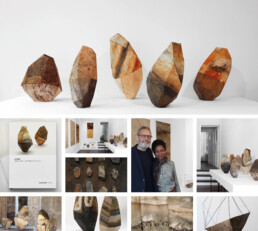
Exibition: Awaré – Objects of Human-Nature Dialogue
Exhibition venue: Culturesphere Gallery, Munich
Project scope: Exhibition concept and design, curation and organisation, communication design, and copywriting.
The exhibition presented the sculptural and textile works of Sylvia Eustache Rools and Jérôme Pereira for the first time in Germany. The French duo collaborate under the name “Awaré”, which stands for the English word “aware”, meaning to be conscious and attentive. It also references the Japanese concept of “mono no aware”, which expresses an awareness of the transience of things and a deep appreciation of their fleeting beauty.
Excerpt from the exhibition text: Sylvia and Jérôme share a deep fascination for geology and a sensitivity for the aesthetics of natural processes of change. Sylvia’s textile works are dedicated to the phenomena of oxidation, and through her multi-layered methods she creates chromatic landscapes that blur the boundaries between artefact and nature. Jérôme brings a scientific understanding from his studies in physics and geophysics together with a poetic sensitivity to matter and the forces of nature to his rough yet graceful wooden sculptures.
As a duo, the two artists create sculptural artefacts that represent an inspirational dialogue between natural transformation processes and the human hand. Their unique objects also convey the constructive collaboration of two artistic personalities who, with their individual approaches and materials, explore permeable boundaries and create new connections.
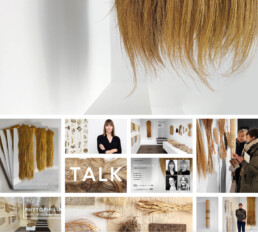
Exhibition: Phytophilia
Exhibition venue: Culturesphere Gallery, Munich
Project scope: Initiation and curation of the exhibition, communication design, copywriting, organisation and co-hosting of an accompanying panel talk. The project was developed as part of my work for Symbio(s)cene, a non-profit organisation that I co-founded.
The exhibition presented sculptural objects by Sara Martinsen alongside her material encyclopaedia on the subject of plant fibres. Martinsen explores the aesthetic and functional potentials of plant fibres, which are of great relevance for the fields of product and textile design, applied art and architecture, especially with regard to transformative change. The exhibition was complemented by an international panel talk. Speakers: Sara Martinsen, Dr. Kirsten Scott, Dr. Svenja Keune, Jess Redgrave. Recordings can be viewed via the following links:
Panel Talk Part 1 & Panel Talk Part 2
Excerpt from the exhibition text: In addition to Sara Martinsen’s sculptural pieces, the exhibition presents her extensive collection of materials from the “Phytophilia” encyclopaedia. The Danish designer has archived her collected knowledge about possible applications and ecological background information of these renewable and completely biodegradable raw materials in a digital encyclopaedia in order to make it accessible to a broad public. The fibres are shown in various states: natural and unprocessed; debarked; prepared for further processing; as ready-to-use fabric samples or building material.
The motivation for the long-term project was Martinsen’s desire to gather comprehensive information on sustainable materials and manufacturing processes for her own furniture designs. In addition to conveying knowledge, the designer is primarily interested in increasing sensitivity of the senses. Visitors are therefore invited to experience the exhibits haptically. In doing so, she wants to provide a deeper understanding and sensitivity to the properties of plant fibres and thus generate new impulses for future application scenarios.
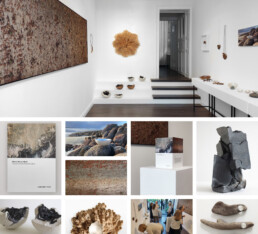
Exhibition: Matter Moves Mind – Towards a New Material Culture
Exhibition venue: Culturesphere Gallery, Munich
Project scope: Exhibition concept and design, curation and organisation, communication design, and copywriting.
The exhibition focused on five artists and designers who, with their approaches, methods and objects, offer inspiring impulses for a more sustainable material culture and encourage future-oriented perspectives. It presented works by renowned artists: Martina Dempf, Emmanuel Heringer, Zena Holloway, Cara Murphy and Jochen Rueth.
Excerpt of the exhibition text: The current global crises show that we need to fundamentally reconsider our ways of thinking and acting as individuals and as a society. Doing so, we must be aware that we do not act in isolation from the physical world. Instead, our perceptions, emotions, social relationships and even our bodies are shaped by the material world that surrounds us, which thus has a significant impact on our thoughts and actions.
Hence, there is a reciprocal relationship between matter and mind, which manifests in our material culture. Consequently, the things we create and surround ourselves with go far beyond form and function: they embody and reflect how we think. Artists and designers have always contributed to shaping material culture, which makes them important players in the context of transformative change.
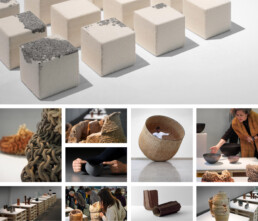
Exhibition: Crafting New Perspectives
Exhibition venue: Gmund Paper, Gmund am Tegernsee
Project scope: Exhibition concept and design, curation and organisation, communication design, and copywriting.
The exhibition placed contemporary craft in the context of organisational innovation, examining how creative processes and artistic approaches can open up new perspectives. Eight renowned artists were selected for their distinctive methods and for the capacity of their work to make adaptability, experimentation and transformation tangible: Michal Fargo, Stewart Hearn, Emmanuel Heringer, Susanne Holzinger, Cecil Kemperink, Richard McVetis, Laurenz Stockner, and Peter Vogel.
Creative thought thrives in environments that encourage curiosity, openness and the freedom to move beyond established patterns. Innovation, in this sense, lies not only in creating something new, but in seeing things differently—making unexpected connections, questioning assumptions and allowing alternative possibilities to emerge. Aesthetic and sensory experience can be instrumental in challenging habitual perceptions. Contemporary craft draws on material knowledge, skilled making and an experimental approach to give these qualities tangible form.
Its processes often move between reflection and intuition, precision and uncertainty, tradition and change. Beyond these characteristics, craft also embodies values of attentiveness, patience and care, together with an appreciation of expertise, continuity and knowledge developed over time. In a culture increasingly shaped by speed, abstraction and standardisation, such values offer a meaningful counterpoint: they affirm the importance of human agency, material responsibility and lasting quality.
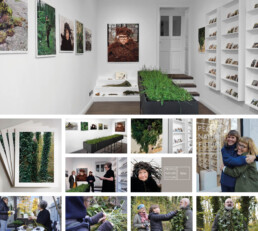
Exhibition: People – Nature – Future
Exhibition venue: Culturesphere Gallery, Munich
Project scope: IInitiation and curation of the exhibition, communication design, and copywriting, organisation and co-hosting of an accompanying talk series, and facilitation of two new artworks produced during a photo shoot in the Oberföhringer Forest near Munich. The project was developed as part of my work for Symbio(s)cene, a non-profit organisation that I co-founded.
The exhibition presented the internationally acclaimed works of the Scandinavian artist duo Karoline Hjorth and Riitta Ikonen. In their remarkable art project Eyes as Big as Plates, ongoing since 2011, the artists explore the relationship between humans and nature. To this end, they have travelled the world and portrayed people in a wide variety of landscapes. The portrait series shows individuals wrapped in artistic sculptures made from elements of their surroundings. Nature serves here both as content and context. With playful ease and an aura of stillness, the artists create symbiotic narratives and new aesthetic worlds that convey a powerful message: We are nature!
As part of their ongoing exploration, Hjorth and Ikonen have carried out art projects in Norway, Finland, France, the USA, the UK, Iceland, the Faroe Islands, Sweden, South Korea, the Czech Republic, Japan, Senegal, the Outer Hebrides, Tasmania and Greenland. In connection with the exhibition People – Nature – Future, the duo visited Munich and its surroundings for two new photo shoots, resulting in the portraits Tina (Germany 2021) and Michael (Germany 2021). The project was complemented by a series of talks exploring relationships between people, nature and possible futures.
A recording of the exhibition walk-through with the artists can be viewed here: Exhibiton Walk Through
Recordings of the accompanying talk series, together with documentation of the making of the two new artworks, can be found here: Talks & Making Of