

Selected Editorial Work
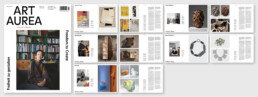
Edition: ART AUREA ISSUE #63
Section: Curators’ Choice
Project scope: Artist research, writing and editing feature articles, image editing, editorial design
Spanning 20 pages, this edition’s Curators’ Choice section of Art Aurea presents five outstanding artistic positions, each distinguished by a highly individual understanding of material, form and process. Charlotte Culot translates the chromatic architecture of her paintings and collages into art rugs, allowing colour and composition to move beyond the pictorial plane and acquire a tactile, spatial presence.
Alan Meredith reinterprets the familiar cabinet as a sculptural study of surface and containment, allowing the inherent tensions of burr oak to animate its precisely worked exterior in striking contrast to the refined, composed space within. Bibi Smit translates the patterns and rhythms of the natural world into luminous blown-glass forms, drawing on the fluidity of the material to evoke a continuous sense of movement and transformation.
Alvina Jakobsson builds monochromatic ceramic sculptures from repeated curves and folds, assembling hand-formed elements into intricate, organic structures defined by softness and fluidity. Nikolay Sardamov constructs jewellery from circular and geometric elements, developing rigorous structures into playful compositions that explore pattern, density and volume.
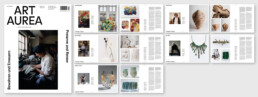
Edition: ART AUREA ISSUE 61
Section: Curators’ Choice, Interview
Project scope: Artist research, writing and editing feature articles, image editing, editorial design
The Art Aurea edition 61, Preserve and Renew, considers the delicate relationship between continuity and change. This edition’s Curators’ Choice section features five distinct artistic positions, each shaped by a highly individual approach to materials and making. Camilla Iliefski creates hand-tufted textile works in which luminous fields of colour, flowing lines and irregular contours extend the language of tapestry towards painting and sculpture.
Mark Reddy carves locally sourced green wood into sculptural spoons and vessels, giving ancient utilitarian forms a contemporary presence while preserving the immediacy of the material and the visible trace of the hand. Sabine Lintzen draws on historical glassmaking traditions and her close observation of natural structures, transforming inherited techniques into intricate contemporary compositions of colour, pattern and light.
Nicole Prues builds her ceramic sculptures coil by coil, creating tactile, organic forms that move between abstraction and figuration and evoke the ambiguity and vitality of the living world. Ela Nord transforms everyday and industrial materials into unconventional jewellery, using imitation and material experimentation to question notions of preciousness and our reliance on finite natural resources, while exploring the potential of transformation and renewal.
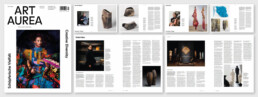
Edition: ART AUREA ISSUE 59
Section: Curators’ Choice, Interview
Project scope: Artist research, writing and editing feature articles, conducting and editing interview, image editing, editorial design
This edition of Art Aurea explores the notion of creative diversity through distinctive artistic positions and material approaches. The Curators’ Choice section features Konrad Koppold, who transforms oak into asymmetrical, thin-walled vessels and sculptural objects, using multi-axis turning and carefully worked surfaces to bring the grain and inherent character of the wood into dialogue with precisely balanced forms.
Hanne Friis constructs dense, corporeal textile sculptures from countless folds of fabric, meticulously shaped and hand-stitched into organic formations that evoke processes of growth, transformation and decay.
For this edition, I also conducted an interview with London gallerist Sarah Myerscough, one of the most influential figures in contemporary craft and a longstanding advocate for material-led artistic practice. Our conversation touched on the evolving position of craft within the wider art world, the importance of conscious material choices, and her deep interest in practices that explore our relationship with nature and the environment.
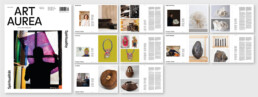
Edition: ART AUREA ISSUE 58
Section: Curators’ Choice
Project scope: Artist research, writing and editing feature articles, image editing, editorial design
Edition 58 of Art Aurea explores spirituality and the ways artistic practice can reach beyond the visible and tangible. The Curators’ Choice section brings together five artists working across textiles, jewellery, glass, ceramics and basketry. Daniel Costa moves between art, craft and design, working with natural fibres and materials to create tactile works in which material, handwork and inner experience are closely intertwined.
Coco Sung creates richly layered jewellery and brooches that echo amulets, talismans and devotional objects, combining colour, symbols and diverse materials to form intimate personal and cultural narratives. Joe Hogan weaves willow grown near his home at Loch na Fooey together with locally gathered natural materials, extending traditional basketmaking into sculptural forms deeply rooted in the surrounding landscape.
Zsolt József Simon creates porcelain sculptures whose organic forms appear caught in transformation, balancing movement and stillness while drawing inspiration from vegetation and architecture. Morten Klitgaard draws on the rugged coastal landscape of northern Denmark, creating glass works with weathered, tactile surfaces that evoke erosion, the passage of time and the fragile complexity of the natural world.
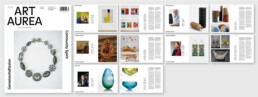
Edition: ART AUREA ISSUE 57
Section: Curators’ Choice
Project scope: Artist research, writing and editing feature articles, image editing, editorial design
In edition 57 of Art Aurea, the Curators’ Choice section brings together five artists whose practices reveal unexpected possibilities in material, technique and tradition. Ptolemy Mann combines hand-dyed and woven textiles with expressive applications of acrylic paint in her Thread Paintings, extending her long-standing exploration of colour while dissolving boundaries between textile, painting and design.
Ori Orisun Merhav transforms the extraordinary material world of lac insects into delicate, luminous forms that evoke ideas of growth and coexistence, imagining a future in which design and the natural world are more intimately intertwined. Kate Jones translates the colours, structures and shifting light of the surrounding moorland landscape into engraved glass vessels, bringing a painterly sensibility to glass.
Christoph Leuner transforms MDF and chipboard – materials more commonly associated with utilitarian construction – into meticulously formed hollow bodies that sit between vessel and sculpture, revealing their unexpected tactile and aesthetic qualities. Tiffany Vanderhoop, of Haida and Aquinnah Wampanoag descent, uses beadwork to reinterpret traditional weaving patterns and Naaxiin imagery in contemporary jewellery.
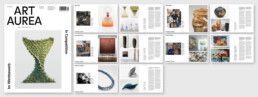
Edition: ART AUREA ISSUE 56
Section: Curators’ Choice
Project scope: Artist research, writing and editing feature articles, image editing, editorial design
This edition’s Curators’ Choice section of Art Aurea brings together five artists from very different cultural contexts, highlighting a broad spectrum of contemporary approaches to material, form and expression. Zhao Jinya explores the sensory and emotional qualities of glass, using layers of colour, transparency and light to evoke atmospheric phenomena and shifting states of perception.
Domingos Tótora transforms discarded cardboard into a tactile, wood-like material, shaping sculptural objects and furniture whose organic forms are deeply connected to the natural landscape. Stefania Lucchetta brings together contemporary jewellery and advanced technology, using materials such as titanium and innovative production techniques to develop intricate geometric structures of remarkable visual and physical lightness.
Jérôme Blanc combines woodturning and carving to produce sculptural forms in which line, volume, material and light enter into a finely balanced dialogue. Claudy Jongstra creates monumental textile works from wool, traditional felting techniques and plant-based dyes, grounded in a profound commitment to ecological and regenerative practice.